Adnan Enterprise: Bilingual Website for a Coal and Limestone Importer
Planned, designed and built an English and Bangla website for a family coal and limestone importer in Sunamganj, turning WhatsApp photos and clips into a fast, trustworthy site for bulk buyers.
- Client
- M/S Adnan Enterprise
- Sector
- Commodities trading (coal and limestone)
- Role
- Discovery, content and media audit, logo redraw, three design directions, PHP build, Bangla localisation, SEO and keyword research, security hardening, Hostinger launch
- Timeline
- 2026
The problem
The client
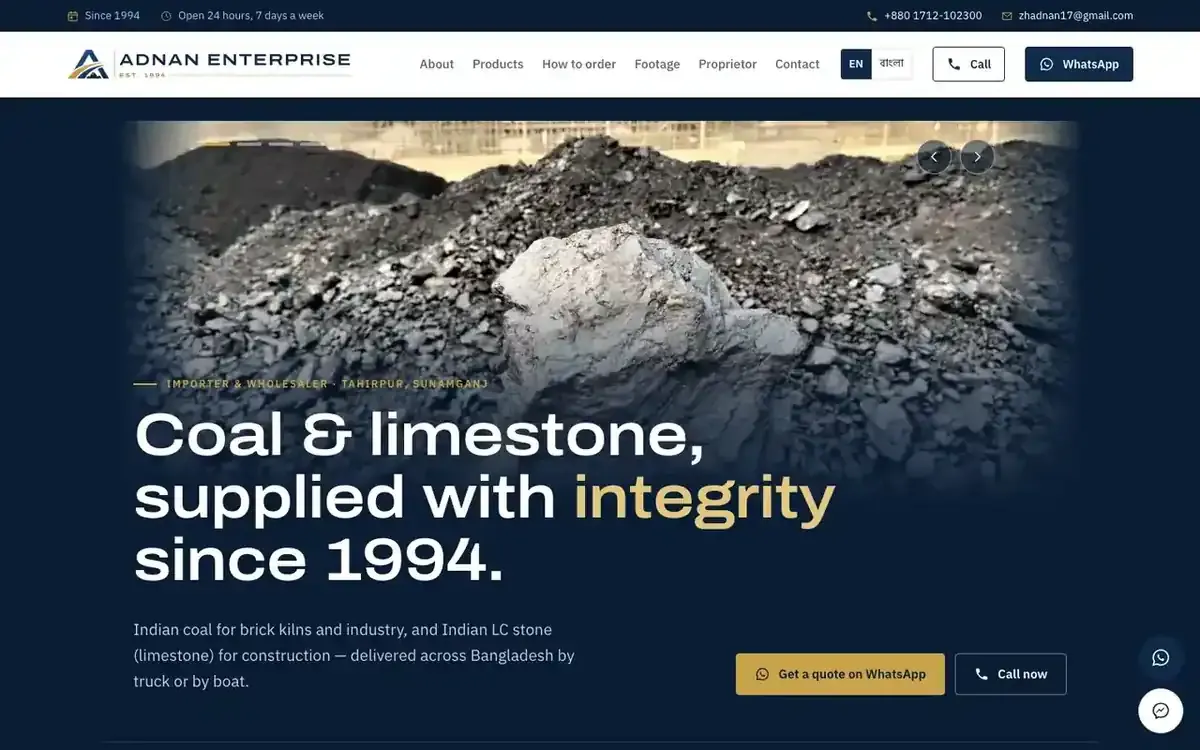
M/S Adnan Enterprise is a family business in Tahirpur, Sunamganj, close to the Meghalaya border. Founded in 1994 by Md. Rafiqul Islam and now run by his youngest son, it imports Indian coal and Indian limestone (sold in the market as LC stone) and supplies them in bulk by truck and by boat.
Its buyers are brick kiln owners, industrial coal users, road and building contractors and lime makers. These are people who order a truckload or a boatload at a time, and who decide quickly by phone or WhatsApp. The business had a domain, a Facebook page and a business card. It had no website and no logo file.
What I had to work with
Everything arrived over WhatsApp: 9 photos, 14 phone videos, three short Word documents (about us, the proprietor's profile and contact details) and two PDFs (the trade licence and a chamber of commerce certificate). The only logo was the one printed on the business card.
The material was real, which was its strength: coal stockpiles at the depot, limestone yards under misty hills, barges being unloaded at the ghat. But it was also compressed, mostly vertical, and mixed with duplicates, selfies and a promo video whose text overlays named the wrong office.
What the site had to do
- Make a small family trader look established. Bulk buyers are trusting the supplier with large orders. The site had to feel as solid as a bank, not like a marketplace listing.
- Get the order started on WhatsApp or by phone. No forms. One tap to call, one tap to open WhatsApp with a message already filled in for coal or limestone.
- Work in English and Bangla. Many buyers search and read in Bangla, so both languages needed their own pages, written naturally, not machine translated.
- Say only what the business can stand behind. No invented customers, certificates or lab results.
- Be easy to keep up to date on cheap shared hosting, with no database or CMS for the client to manage.
Approach
Phase 0: Planning
Facts first
Before any design, I turned the documents and calls into one written brief, with a short list of confirmed facts that overrode everything else, including the business card. Phone numbers, office and depot locations, opening hours, the products, minimum orders and delivery points all went into it.
I also wrote down which numbers the site was allowed to show: Since 1994, up to 4,000 tons a month, 6,000+ kcal/kg calorific value, 16 to 25 tons per truck, 160 tons per boat, four truck delivery points, open 24/7. Anything outside that list stayed off the site.
That rule shaped the copy. The client had no lab report, so the coal card says "calorific value 6,000+ kcal/kg (typical)" and never "lab tested" or "low sulphur". Ash, moisture and sulphur fields exist in the config, but stay hidden until there is a report to back them up.
For anything still missing, I sent a bilingual question sheet (English and Bangla side by side) covering coal quality, sizes, capacity, delivery, credentials and which phone numbers could be public. Every answer was optional. A question left blank simply meant that detail stayed off the site.
Auditing the media
I went through every file and renamed the useful ones with clear names, keeping a map back to the original WhatsApp file names:
- 5 photos kept for the site. The proprietor's portrait was cropped from a wider photo, with a light exposure lift and no other retouching.
- 10 reels cut from the videos, each trimmed to its best 30 seconds or less.
- Skipped: one clip that was a byte-for-byte duplicate (same MD5 hash), two selfie clips, one informal portrait, and the business card (used only as the logo source).
- Used with care: a promo video whose overlays named the wrong head office. I kept the confirmed facts and took only clean frames from it.
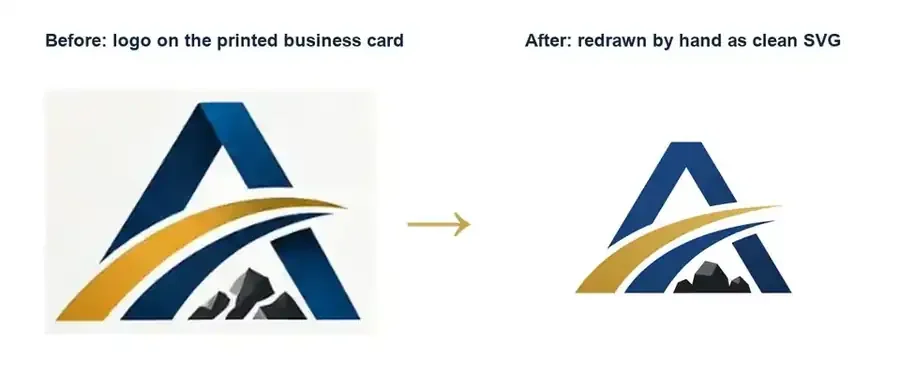
Redrawing the logo
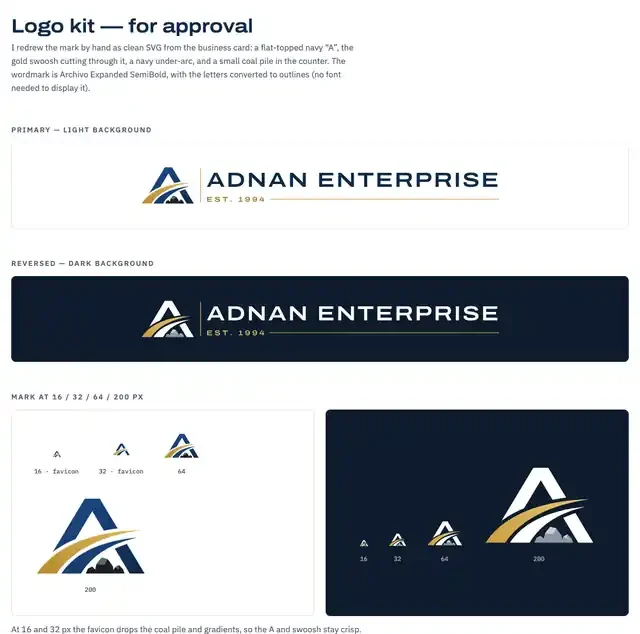
The logo existed only as a printed card in a phone photo. I redrew it by hand as clean SVG: a flat-topped navy A, a gold swoosh cutting through it and a small coal pile inside. At 16 and 32 pixels the favicon drops the coal pile and the gradients so the A stays crisp. The kit includes horizontal, reversed and single-colour versions, app icons and a Bangla lockup set in Hind Siliguri.
Phase 1: Design
I agreed a hard stop with the client: three directions first, no code until one was chosen. Each direction was a full homepage built with the real photos and copy, checked at 375 px and 1440 px, with one Bangla section to prove the type worked.
- A, Dark editorial: charcoal and warm gold, large serif headlines, cinematic full-width photos. A premium commodities house.
- B, Navy and gold corporate: the business card's colours refined into a clean, structured, bank-like layout.
- C, Earthy documentary: sand tones, condensed headlines and big captions. Grounded and photo-led.
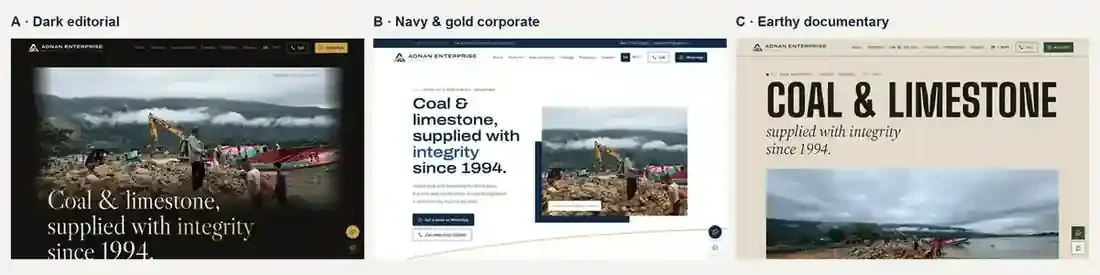
I shared all three in one private page with tabs, plus a fourth tab for the logo kit. The client chose B but liked A's full-width hero slider, so the final design is B with A's hero: navy and gold, Archivo for headings, Hind for body text in both scripts, and a gold reserved for the one word that matters in each headline.
One colour detail: the card's gold (#C9A24A) fails contrast as text on white, so the site uses a darker gold (#8A6A22) for text and keeps the bright gold for shapes and buttons.
Phase 2: Build
A stack the client can live with
The site is plain PHP 8 includes, HTML, CSS and about 9 KB of vanilla JavaScript. No framework, no database, no build step. It runs on Hostinger shared hosting by unzipping one file into public_html.
PHP does two jobs only: shared includes and language strings. That keeps editing simple:
- All text lives in
lang/en.phpandlang/bn.php. - All business data lives in one
config.php: phone numbers, WhatsApp messages, capacity, minimum orders, delivery points, buyer districts, hero slides and reels. - Empty means hidden. Set a figure to an empty string and its stat, card line and FAQ mention disappear everywhere.
- Bangla numerals are automatic. Figures are written once in English digits and converted on the Bangla pages.
One long page, in order of a buyer's questions
The homepage runs: hero, about and founder, credentials, products, who we supply, how to order, footage, proprietor, locations, FAQ and contact. Floating WhatsApp, Messenger and call buttons stay in reach on mobile.
- Products show the facts a bulk buyer checks first: origin, calorific value, capacity, sizes, and truck or boat delivery. Each card has its own "Request a quote" button that opens WhatsApp with a product-specific message in the visitor's language.
- How to order follows the real supply chain (sourced in Meghalaya, carried by barge, stocked at the Borchora depot, then boat or truck) with photos from the client's own footage, so the truck and boat cards actually show coal being loaded.
- Footage is a grid of eight vertical reels. Nothing autoplays: each is a poster image until tapped, then plays in a modal one at a time. Clips are H.264, audio stripped,
preload="none", about 2 MB each, so they cost nothing until someone asks for them. - Credentials show the trade licence and chamber certificate as small thumbnails with numbers, ID and QR codes blurred.
A map without Google Maps
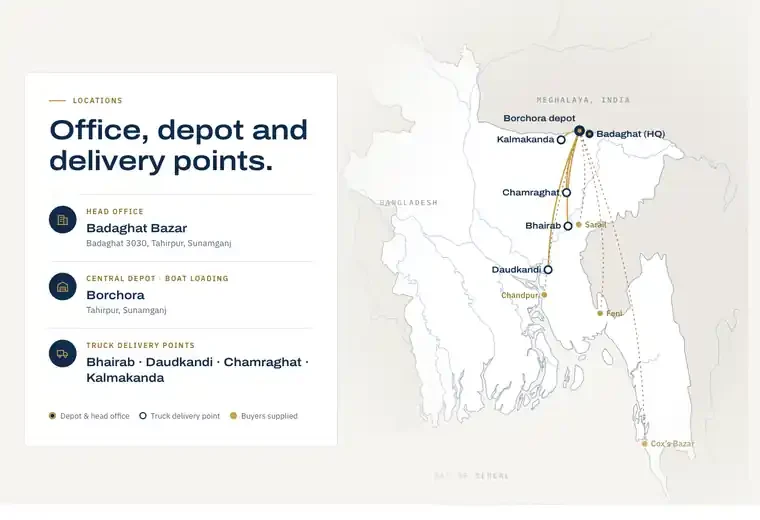
I drew the locations map as SVG from public-domain Natural Earth data: the head office, the depot, the four truck delivery points and the districts where regular buyers are. It loads instantly, needs no API key or cookie banner, and matches the site's colours.
Bangla done properly
English lives at / and Bangla at /bn/, each with its own title, description, canonical URL and hreflang links. The Bangla copy was written for Bangla readers, with place names spelled the way locals write them. I self-hosted Hind Siliguri, checked line heights so conjuncts don't clip, and tested that nothing overflows at any width.
Keyword research that changed the copy
I researched real search demand with Google autocomplete for Bangladesh, in English and Bangla, across about 70 seed phrases. Two findings changed the site:
- Buyers search for prices, not suppliers. Phrases like "price of one ton of coal" and "LC stone price 2026" repeat every year, and the current results are old news stories and marketplace listings.
- "Limestone" isn't the market's word. The client's stone sizes are sold as LC stone (এলসি পাথর) and dhalai stone (ঢালাই পাথর).
The first round of changes went straight in: the market's terms in headings, titles and the FAQ, plus "brick kiln coal" and "coal importer" where they read naturally. Each page also carries structured data for the business, its products, the proprietor and the FAQ. There is a sitemap.xml with image entries, a robots.txt open to search and AI crawlers, and an llms.txt fact sheet. A dedicated, regularly updated price page is the next step, once the client decides how much pricing to publish.
Secure by default on shared hosting
The .htaccess forces HTTPS, redirects www to the bare domain and sends a strict set of security headers (HSTS, CSP, X-Frame-Options, Referrer-Policy and others). It blocks direct access to inc/, lang/, dotfiles, backups and every PHP file except the public pages. A separate rule stops any script from running inside /assets. The site has no forms, so it only accepts GET and HEAD requests.
Launch and the first fixes
I tested on Apache before handover and wrote a README covering upload, editing text, changing figures and adding a reel. The client's site went live on Hostinger. In the following days I fixed a few things found on real devices: card badges clipping, a seam in the mobile hero, the header overflowing between 1081 and 1280 px, and the language switch, which moved into the mobile top bar and the footer so it's never hidden behind the menu.
Results
- Mobile Lighthouse performance
- 92
- Accessibility, Best Practices, SEO
- 100
- Languages
- 2
- Homepage weight before reels
- 621 KB
- Live in English and Bangla at adnanenterprise.com.bd, with separate, properly linked pages for each language
- Mobile Lighthouse 92 to 93 for performance, and 100 for accessibility, best practices and SEO, on both language versions
- No layout shift (CLS 0) and 20 ms total blocking time on mobile
- 621 KB homepage before any reel is played. The eight reels load only when tapped
- One-tap enquiries: call, WhatsApp with a pre-filled product message, or Messenger, from every section
- Owned by the client: text, numbers and media all change in two language files and one config file, with no database or CMS
- A clean logo kit from a phone photo of a business card
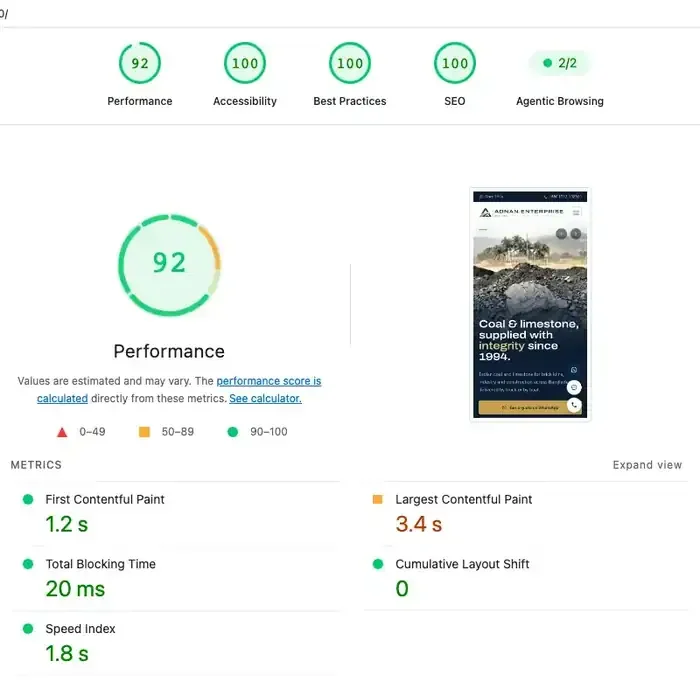
The Lighthouse runs above were made on a local build just before launch.
What I'd do differently
- Ask for original files on day one. WhatsApp compression cost a lot of image quality. The question sheet asked for originals through Google Drive, but asking before the first design would have given every page sharper photos.
- Settle the pricing question early. The keyword research showed that price searches drive most of the demand. Agreeing up front how much to publish would have let the price page ship with the site, instead of following it.
- Preload the first hero image. Largest Contentful Paint (3.4 s on mobile) is the one Lighthouse metric below green, and it comes from the hero slider's first photo.