M-Smart Technology BD: Corporate Website for a Garment CAD Supplier
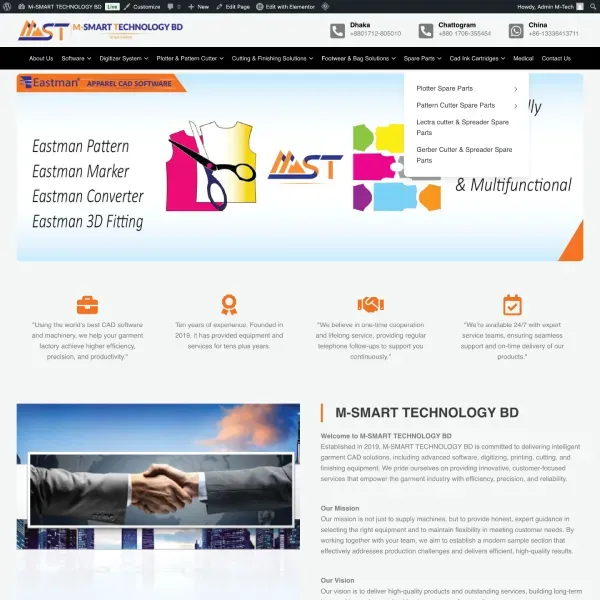
The first website for a garment CAD and machinery supplier: a WooCommerce catalogue of 60+ categories with WhatsApp enquiries, built and looked after for over three years.
- Client
- M-Smart Technology BD
- Sector
- Industrial technology supply
- Role
- Website design and build (as CrocoDevs), WooCommerce catalogue, speed and three years of maintenance
- Timeline
- 2022
The problem
Where it started
M-Smart Technology BD supplies the garment industry in Bangladesh. Its range covers CAD software for pattern making, digitizers, plotters and pattern cutters, fabric spreading, cutting and inspection machines, footwear and bag solutions, spare parts and plotter ink cartridges. It works from offices in Dhaka and Chattogram, with a sourcing office in China.
The company came to me directly, through my studio CrocoDevs. It had no proper website. Buyers learned about products from sales visits, phone calls and word of mouth, and the range was far too wide to explain in a conversation.
Who the site is for
The buyers are garment factory owners, production managers and CAD operators. They know exactly what a spreading machine or a plotter does. What they need to know is: does M-Smart have the model I need, what are its specifications, and who do I call?
These are not impulse purchases. A cutting machine is quoted, discussed and negotiated, often over WhatsApp, which is how much of Bangladesh's business actually runs. So the site did not need a checkout. It needed to be a clear catalogue that ends in a conversation.
What made it hard
- A huge, deep range. Machines, software, spare parts and consumables, many with sub-types: knit and woven spreaders, manual and automatic lay-end cutters, plotter inks for half a dozen printer brands. The category tree grew to more than 60 categories.
- Technical product content. Most product details came from Chinese manufacturers' documents and had to be turned into clear specifications.
- A heavy stack on a phone. Many buyers browse on mobile networks, so a big catalogue still had to load fast.
- A long life. The site would be added to for years, so every update had to be safe.
Approach
WooCommerce as a catalogue
I built the site on WordPress with the Astra theme and Elementor Pro, and used WooCommerce for the catalogue, not for checkout. WooCommerce gives products, nested categories, images, attributes and search for free, and the team already understood how to add a product.
Instead of a basket, every product leads to contact.
Contact that matches how buyers work
- WhatsApp first. A WhatsApp button sits on every page, so a buyer can send a question about a machine in one tap, from the product page they are looking at.
- The right office. Phone numbers for Dhaka, Chattogram and the China office sit at the top of every page, so buyers call the office nearest to them.
- Quotes on request. Machinery prices depend on the configuration and the deal, so the catalogue invites an enquiry rather than showing a price.
Organising a range that keeps growing
The category tree was the hardest part to get right, and it kept growing over the years. I grouped it by how a factory thinks about its production line, not by supplier:
- Pre-production: CAD software, photo and table digitizers, plotters and pattern cutters
- Fabric handling: spreading machines for knit and woven, relaxing, rolling, shrinking and inspection machines
- Cutting and finishing: automatic fabric cutters, lay-end cutters, sample cutters and template sewing machines
- Footwear and bags: CAD software, digitizers, scanners, pattern and laser cutters
- Consumables and parts: plotter ink cartridges by printer brand, and spare parts
Ink cartridges show why the depth matters. A CAD operator searches for the cartridge that fits their plotter, so each brand gets its own category.
The home page leads with Best Selling Products and the main product lines, then the company story and the customers it already serves, for trust.
Turning supplier documents into specifications
Product content was the slow part. Manufacturers' documents were often long, inconsistent or loosely translated. For each product I pulled out what a buyer compares, such as working width, speed, power and compatible models, and kept it in a consistent order so products are easy to compare.
Keeping a big site fast
Elementor and WooCommerce together are heavy, so speed needed ongoing care: LiteSpeed Cache for page caching, compressed and properly sized images, and keeping plugins to the ones the site actually uses.
Three years of care
I looked after the site for more than three years:
- Updates to WordPress, WooCommerce, Elementor and plugins, checked so the catalogue kept working
- New products and categories as the range grew
- Fixes and content changes whenever the company needed them
A catalogue like this is never finished. The value comes from it staying accurate.
Results
- Maintained for
- 3+ years
- Product categories
- 60+
- Offices on every page
- 3
- The company's first website, presenting the full range in one place
- A WooCommerce catalogue with more than 60 categories, organised around a factory's production line
- WhatsApp and three office numbers on every page, so every product page ends in a conversation
- Fast on mobile despite the size of the catalogue, with LiteSpeed caching
- More than three years of maintenance, with the site kept up to date as the range grew
What I learned
- Build for how the market buys. In Bangladesh, B2B sales often happen on WhatsApp and the phone. A catalogue that makes those conversations easy beats a checkout nobody will use.
- Structure is the real design work. The look took days. The category tree took years of refinement, and it is what makes a big catalogue usable.
- Long-term care is part of the product. A site that stays accurate and up to date for three years is worth more than a launch that looks good for one.