Cardinal Health Care BD: Medical Devices Website on a Custom Block Theme
Gave a Bangladesh medical device distributor its first website in about ten days: a 27-product catalogue on my own block theme, with news and enquiries.
- Client
- Cardinal Health Care Ltd
- Sector
- Medical devices
- Role
- Catalogue planning, block theme and child theme, product content and launch
- Timeline
- 2026
The problem
Where it started
Cardinal Health Care distributes medical devices in Bangladesh, working with the Genoss family of manufacturers. Its products range from coronary stents and catheters to dermal fillers, bone graft material, trauma plates and ENT devices. The buyers are cardiologists, surgeons, dentists, clinics and hospital purchasing teams.
The project came to me through a personal connection. The company had no website at all. Product information lived in manufacturers' brochures and spec sheets, and anyone who wanted to know what Cardinal supplied had to ask.
For a medical supplier, that's a real gap. A hospital buyer who hears your name will search for it. If nothing comes up, or only a social media page does, you look smaller and less established than you are.
What made it tricky
- Technical products. A drug-eluting stent page needs its strut material, polymer coating, delivery system and clinical outcomes, not marketing copy. The content had to be accurate and readable by specialists.
- A wide, uneven range. Seven product lines, from vascular intervention with fifteen products to lines with a single product, and sub-groups such as catheters, stents, fillers, skin care and trauma devices.
- Trust. The audience is professional and cautious. The site had to look established and calm, not like a template.
- Time. The company wanted to be online quickly, so the whole site had to be planned, built and filled in about ten days.
What the site had to do
- Present every product line clearly, with a proper page for each product.
- Let doctors and buyers find a product by what it is, not by browsing a long list.
- Make it easy to get in touch.
- Let the company's own staff add products and news without a developer.
Approach
Not a shop, a catalogue
The first decision was what not to build. Cardinal doesn't sell online. Medical devices are sold through quotes, tenders and relationships, so a cart, a checkout and payment gateways would only add weight, settings and things to update.
What the company needed was a catalogue: products with good pages, organised into categories, plus a way to make contact.
Reusing my own listing theme
I had already built a full-site editing block theme with a custom listing type for Sylhet Helpline, a local directory project. A directory and a product catalogue turn out to need almost the same things:
- a dedicated content type for the items, separate from blog posts
- nested categories with their own archive pages
- a single page layout with breadcrumbs
- custom blocks for the home page, such as a hero slider and navigation
So instead of starting from nothing, I used that theme as the base and put everything specific to Cardinal in a child theme: the brand colours and type, the templates, and the labels. Visitors see /products/ and Products, never "listings". The parent theme stays clean, so improvements to it can be reused without breaking either site.
This reuse is the reason the site could be built in about ten days. The plumbing already existed. The time went into the parts that were unique to Cardinal: the structure and the content.
The theme is a block theme with no page builder. Pages load little beyond what they show, and staff edit products and news in the normal WordPress editor.
Organising 27 products
Getting the categories right took longer than any code. The manufacturers' brochures group products their own way, but a cardiologist and a cosmetic clinic look for things differently.
I settled on seven top-level lines, matching how the company sells: Vascular Intervention, Aesthetic, Cosmetic, Dental Biomaterials, Orthopedic Devices, ENT Devices and Medical Devices. Underneath sit the groups that a specialist actually thinks in, such as stents, catheters, fillers, skin care, hair care, regeneration and trauma devices.
That gave 16 categories in all, each with its own archive page, and the home page shows the main lines as clear entry points.
Turning spec sheets into product pages
The hardest work was the product content itself. Each product page follows the same pattern, so a visitor always knows where to look:
- Description: what the product is and what it is used for
- Specification: the technical details, for example strut thickness, alloy, coating and delivery system for a stent
- More information: supporting detail such as comparative characteristics or clinical outcomes, where the manufacturer provides it
I worked from the manufacturers' brochures and kept the wording close to the source. On a medical site, being accurate matters far more than sounding clever. A doctor would rather read the real strut thickness than a slogan.
The rest of the site
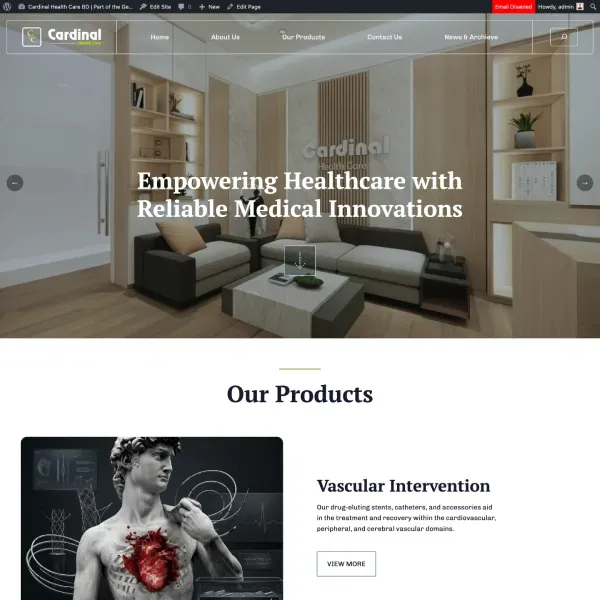
- Home page: a hero slider, the product lines, a look inside the workplace, and a short introduction to the company
- Company pages: a greeting from the company, its values and its network
- Contact: a simple enquiry form
- News: seven articles at launch on questions buyers actually search for, such as choosing a medical equipment supplier in Bangladesh, what a new hospital needs, and oxygen concentrators compared with cylinders
- Google: Search Console and Analytics are connected through Site Kit, so the company can see how people find the site
The company's staff add new products and news themselves, in the standard WordPress editor.
Results
- Products at launch
- 27
- Product categories
- 16
- Build time
- ~10 days
- Launch articles
- 7
- The company's first website, planned, built and launched in about ten days in March 2026
- 27 products at launch across seven product lines and 16 categories, each with a full product page
- A consistent product page of description, specification and more information, so specialists find the details fast
- Seven articles at launch to help the site appear for real buyer searches
- No page builder and no shop plugins, so there is less to update and less to break
- Staff can add products and news in the standard WordPress editor
What I learned
The best code on this project was code I had already written. Building the listing theme properly for an earlier project, with the generic parts in the parent theme and the specifics kept out of it, is what made a ten-day build possible.
The other lesson is that on a specialist site, the content is the product. The theme took days. Getting 27 technical products into a clear structure, with accurate details, is what makes the site useful to the people who buy from it.