Tu Flamenco: Dance School Website Redesign with WooCommerce Bookings
Rebuilt a Scottish flamenco school's WooCommerce site so students book classes and buy show tickets easily on their phones.
- Client
- Tu Flamenco
- Sector
- Dance school and performing arts
- Role
- WordPress and WooCommerce rebuild, booking setup and site support
- Timeline
- 2022 – now
The problem
Where it started
In 2022 the owner of Tu Flamenco, a flamenco school and performance company in Scotland, asked me to rebuild the school's website.
The school already sold online. The old site ran on WooCommerce, so in theory students could book a class and audiences could buy a ticket. In practice, the experience pushed people away from the website and back to email.
What was wrong with the old site
- A confusing checkout. Finding the right class at the right level on the right day took too many steps, and it was easy to buy the wrong thing. Every mistaken order meant emails to sort it out.
- Poor on phones. Most people find a dance class on their phone, often straight from social media. On a small screen the old site broke or looked unfinished.
- Slow. Pages took a long time to load, which is the worst moment to lose someone who has just decided to try flamenco.
- Hard to update. The owner couldn't add a new term or a new show without help, so the site was often behind the timetable.
None of this was a WooCommerce problem as such. It was a problem of how the shop had been put together. A dance school doesn't sell products the way a normal shop does. It sells places in a class and seats at a show, both of which run out, and both of which change every term.
What the new site had to do
- Let a new student find the right class and book it on a phone in a few taps.
- Stop selling places that don't exist, for classes and for shows.
- Give the school a clean list of who is coming, without retyping orders.
- Let the owner keep the site current, with help on hand for the bigger changes.
Approach
Rebuilding the front end
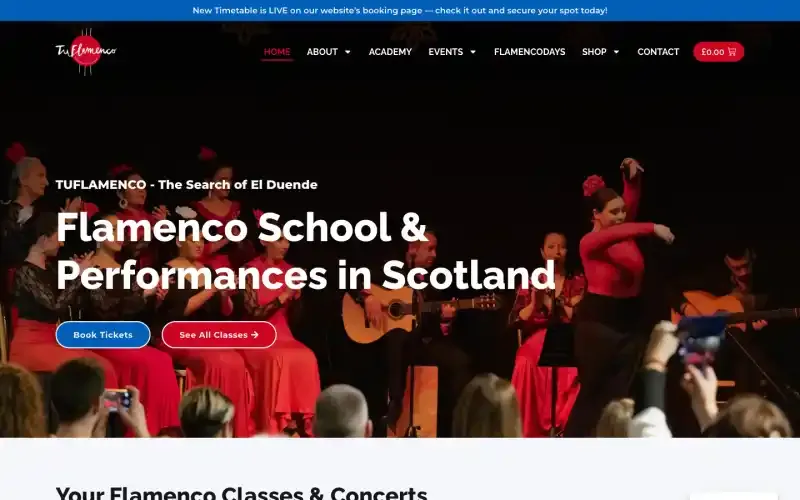
I rebuilt the site on WordPress with Elementor Pro, designed mobile first. The pages that matter most, the class timetable, the class booking pages and the show pages, were laid out for a thumb on a phone before anything else. Calls to action are big and obvious, and every class page answers the questions people actually ask: what level is this, when is it, how much is it, and is there still a place.
The design keeps the energy of flamenco, with bold photography of the dancers and performances, but the booking parts stay calm and plain. When someone is paying, clarity beats decoration.
Classes as variable products
This was the hardest part to get right. A class isn't one thing. It has a style, a level, a day and a term, and each combination has its own limited number of places.
I set classes up as WooCommerce variable products. Each class has variations for the options a student actually chooses, such as level, day and term. Every variation carries its own stock, so each group has its own number of places.
That gives the school a few things for free:
- No overbooking. When a group is full, that option sells out on its own, while other days and levels stay open.
- One page per class. Students see every option for a class in one place, instead of hunting through a long list of near-identical products.
- Clean orders. Each order states exactly which group the student joined, so the teacher's register comes straight from the orders.
The trade-off is setup. Every new term means new variations and fresh stock, so getting that structure right once made every later term much quicker.
Show tickets with real limits
Performances run the same way. Each show is a WooCommerce product with stock equal to the seats available, so tickets stop selling when the venue is full. Orders for each show become the guest list for the door, so nobody retypes names from emails on the night.
It is deliberately simple. A small school doesn't need a seating chart or a separate ticketing platform with its own fees. It needs to sell the seats it has, know who is coming, and stop at the limit.
Speed and checkout
I cut the checkout down to what a class booking needs and tested it on phones, from the class page to the confirmation email. I also worked on speed, so the pages people land on from social media open quickly on a mobile connection.
Mailchimp
The school keeps in touch with students by email. I connected WooCommerce to Mailchimp, so people who book are added to the mailing list automatically, without anyone copying addresses by hand.
After launch
The launch was the start, not the end. After it I looked after the site:
- New terms and new shows. Setting up each term's classes and each show's tickets, with the right variations and stock.
- Updates and backups. Keeping WordPress, WooCommerce, Elementor and the plugins up to date, with regular backups and monitoring.
- Fixes and changes. Sorting out issues and making design and content changes when the school needed them.
For a site that takes money every week, that care matters as much as the original build. A booking system that breaks during sign-up week costs a term's worth of students.
Results
- Launched
- 2022
- Bookings
- Mostly online
- Booking types
- Classes + shows
- Most bookings now happen on the website, for both classes and performances, rather than by email
- Shows and classes have sold out online, with stock stopping sales at the limit, so nothing is oversold
- Much less admin for the owner: registers and guest lists come straight from the orders
- New students join the mailing list automatically when they book
- New terms and shows set up quickly, because the product structure was right from the start
What I learned
A dance school's shop is really a timetable with a till attached. Once the products matched how the school actually teaches, with one class and its real choices and real limits, the rest followed: clearer pages, fewer wrong orders, and an owner who spends less time on email and more time in the studio.
The other lesson is about the long term. Small businesses rarely need a bigger website. They need one that works every week, and someone who knows it well enough to keep it that way.